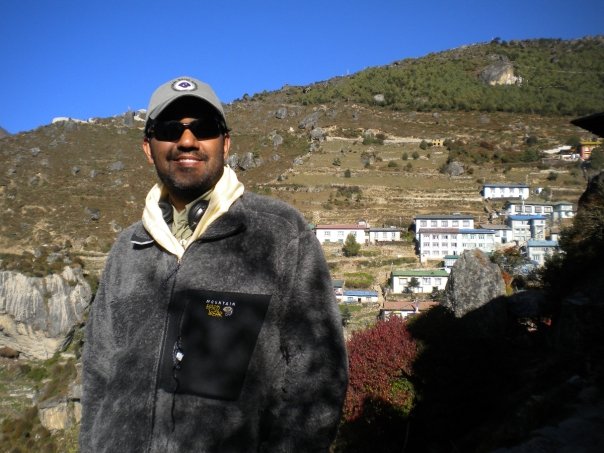
When, not if.
There I was, at the bottom of Namche Hill, something I would affectionately call “Namche Hell” by the end of the day. I looked straight up the mountain at a 2000-foot climb. At sea level this would be difficult but I was already at 9000-feet. Oh boy. What had I gotten myself into?
Two days earlier we’d flown into Lukla, Nepal. An airport at 9000-feet with a runway that points toward the mountain. As we were about to land on the smallest plane I’ve ever seen, I wondered what would happen if we had to abort the landing because it looked like we would run right into the mountain. I saw it all clearly because I could see over the pilot’s shoulder out the front window. Like I said, it was a tiny plane.
I’d been “training” for this for six months. I put training in quotes because it was pretty weak training. I mean, I went to a trainer a few times a week but I never worked out on my own nor did I eat properly. Standing at the bottom of that mountain was the moment I knew I hadn’t worked hard enough. I wasn’t going to make it. That’s a scary thought because there is no where to go but up this mountain.
We’d already been hiking for a few hours, crossed a rope bridge at least 400-feet in the air that we shared with huge yaks and climbed up and down hundreds of feet and I was already exhausted. How was I going to make it straight up a 2000-foot climb?
It didn’t take long for me to get behind everyone. Each of us had a Sherpa assigned to us but I was so slow that my Sherpa had to leave in order to make it up the mountain in time to do all he had to do to prepare for our stay. Oxygen was thin and it was very hard to breath. I was maybe 300-400 feet into my 2000-foot climb and I was scared. I didn’t know if I was going to make it.
It got to the point where I’d take 2-3 steps and then stop and breath for 2-3 minutes. Then I’d take a few more steps and repeat. It was exhausting. Everyone was long gone by then. Here I was, alone, on the side of a mountain in Nepal. It’s not what I pictured when I accepted the opportunity to go to Mt. Everest basecamp.
I tried to focus on my steps and my breathing. It’s something you take for granted but when it’s hard to do it takes on a new level of importance. Step. Breathe. Step. Breathe. I had images of my family flash through my mind. Was that my life flashing before my eyes? I hoped not.
Somehow, I found myself about halfway up the mountain. From time to time, someone would come up from behind me and pass me up the mountain. They would look at me, pathetically. I can’t blame them. I was pathetic. What was I going to do if I didn’t make it? I didn’t have any gear to sleep in and it got very cold at night, especially at this altitude. I was getting really scared and desperate.
That’s when it happened. I turned the corner and sitting there on top of this massive boulder, looking like Robin Hood, was our expedition leader, Jamie Clarke. “What’s up?’ he casually asked. I was in shock. What was he doing here?
He hopped off the rock and asked me if I was okay. I nodded, not believing it at all. He pointed through the trees just past the rock he was sitting on and said, “You see that peak over there in the distance?” I looked and there were a few peaks there. “Which one?” I asked.
“The highest one,” he said. I looked again and there it was. It was far, far away, but it was a clear day and I could make it out. “That’s Mt. Everest,” he said, “The top of the world.” And for the first time that day, I smiled. Wow.
I tried to pick up my pace to walk with him but he told me to take my time. He asked me questions about my life and family and talked about his. We’d been working together for months but this was the first time we really talked. I was amazed that this man who had summited the highest peaks on each continent was here hanging out with me.
I don’t remember the second half of that climb as well as I remember the first half. The first half was pain in every step. It was fear and it was fighting exhaustion. The second half was like a pleasant conversation. It was two friends walking together on a clear, beautiful day. I was the weakest link on the team that day and, Jamie, by far our strongest link, gave some of his strength to me to make it through the day.
It was nightfall when we made it to Namche Bazaar, known as the Gateway to the High Himalaya or the Gateway to Mt. Everest. It’s a trading post where climbers stay to acclimate to the altitude on the way to basecamp.
As Namche Bazaar appeared over the last turn, I saw numerous members of our expedition rushing down to Jamie and me. One of Jamie’s friends, P.P. (those are his initials and what we all called him) ran up, excited to see us. He asked me how I was and, surprisingly, I felt okay.
I said, “You know, before we came to Nepal, I didn’t really know if I could make it to Mt. Everest basecamp but after today, I know it’s not a matter of IF I’ll make it, but WHEN I’ll make it.” Everyone smiled and celebrated. It was an awesome feeling. I came up the mountain hours after everyone else and, with the support of our fearless leader, I did something I was pretty sure I wasn’t going to be able to do.
I learned a number of lessons that day. First, that a true leader has the ability to give his strength to the weakest link in his team and make it stronger. I am forever grateful to Jamie for this and hope that I’ve been able to do the same for others.
Second, and this one has stuck with me over and over again, there is nothing that I cannot do. It may not work out the first time, second time or fiftieth time but eventually, I will conquer whatever it is I put my mind to do.
It is never a matter of if I can do anything, only when I will do it.
 Sympolism.
Leave a comment